About Me

My photo
This is a blog for John Weber. One of my joys in life is helping others get ahead in life. Content here will be focused on that from this date forward. John was a Skype for Business MVP (2015-2018) - before that, a Lync Server MVP (2010-2014). I used to write a variety of articles (https://tsoorad.blogspot.com) on technical issues with a smattering of other interests. I have a variety of certifications dating back to Novell CNE and working up through the Microsoft MCP stack to MCITP multiple times. FWIW, I am on my third career - ex-USMC, retired US Army. I have a fancy MBA. The opinions expressed on this blog are mine and mine alone.

2018/07/12

Landis Contact Center

Now, this is significant.  MVP Matt Landis and his merry band of mavens is getting their contact center out to the world. This is a happy event for those of us looking for just a bit more than nested RGS.

Hot off the email press:

https://www.landistechnologies.com/office365contactcenter/


We Plan to Announce Office 365 Contact Center is Publicly Available as Preview at Microsoft Inspire 2018

We wanted to you to be the first to know what we will be announcing at Microsoft Inspire 2018:
Las Vegas, Nevada 7/16/2018 - At Microsoft Inspire 2018, Landis Technologies LLC is announcing that Office 365 Contact Center is now publicly available as a Preview. The Landis Technologies Office 365 Contact Center provides Microsoft Partners with a call center solution that can be provisioned and running in minutes. To read more: https://www.landistechnologies.com/office365contactcenter/ .... read more


Copyright © 2018 Landis Technologies, All rights reserved.
Landis Technologies Office 365 Contact Center


YMMV


2018/07/09

Sennheiser SfB headset review (July 2018)

This review is going to cover the “Sennheiser SC 75 USB MS Binaural UC Headset USB 3.5mm” (there is a serious product title) and the Sennheiser SD Pro 2 ML DECT Wireless Binaural Headset (a shorter title but still a mouthful).

The 75 is a wired (USB via an inline module adapter thingy).  The SD Pro2 is a DECT wireless.  Both have a place, and both are very nice units.  Both are Binaural.  I tend to run to binaural when at all possible due to my hearing loss.  And music sounds way better.  Two ears are better than one.  Trust me.

But, wired v wireless is a big differentiator.  For the center mass of your office workers, a wired headset will work just fine.  But some people (like me) like the flexibility of the BT or DECT modality so they can walk and talk.  I know several customers who routinely go to the server room and you would never know they are not at their desk.  DECT has a range (projected/published) of 300 feet.  Whether or not you get all of its range is problematical and depends on perfect conditions.

The SC 75:

image

SC 75

Coming out of the box the SC 75 is in two pieces – the cable that plugs into the inline module, and the overall headset.   Pretty basic.  However, that basic stuff is good. Plug it in and it works.  Simple as that.  SfB picked it right up and I was operational.  Teams required that I tell Teams to use it.  After that, seamless. 

The SC 75 audio quality that is a solid 9.5 on the Tsoorad Goodness Scale.  Build quality seems very nice.  Materials are typical Sennheiser.  No ANC, but that is a personal preference.

The SD Pro 2


image


Now this is my type of device.  Wireless.  DECT.  Comfort.  Great quality, both build and audio. ANC. A superior piece of gear.  My SfB client loved it…it did not have to do anything but tell it to be the preferred device one time, and after that, all was golden.  I suspect that the “one time” thing has to do with me having like 12 headsets currently going through testing.

image

Of the two, I spend most of my testing time with the SD Pro 2.  It meets my personal needs better than the wired headset.  Having said that, I need a travel headset also, and the SC 75 does meet that need.  So, the bottom line is, you can’t go wrong with either!

You can get the SC 75 right here, and the SD Pro 2 ML right here – and both worked equally as well with Microsoft Teams as they did with SfB.

YMMV

Yamaha YVC-1000MS-NA Review

Unbeknownst to me, Yamaha, a firm who I thought made great motorcycles and my mother’s piano, is also making a very nice, Skype certified, medium/large conference room audio solution.  Comes OOBE ready to be a speakerphone for the SfB client.  The nice folks at Yamaha let me play with one for a few days. 

Here is what the Yamaha marketing mavens have to say:

“Ideal for medium and large spaces, this intuitive communications system features separate microphone and speaker units for flexibility during audio, web, and video conferencing. Designed to support 2 external speakers and 5 daisy-chained microphones, it’s the perfect scalable solution for accommodating larger meeting rooms and additional participants. Adaptive echo cancellation and human voice activity detection (HVAD) minimize background noise, facilitating natural, stress-free conversation during every call.”

If you poke around their website, Yamaha also has the obligatory case studies.

Ya…. well, OK, it’s good for them to say it, quite another for us lowly consumer types to actually realize it.  Let’s break open the box and see what is what.

The Box

Out of the box, you get a main unit, wires/cables to match, and an external microphone.  There is also a small pamphlet of instructions which I did not read until afterwards.  Does anyone read those things first?

image

Build

One of the first things I noticed was the build quality.  We got good stuff here.  Solid.  Construction on par with what I expected from a musical instrument manufacture (based on mommy’s piano).  And that theme carried through acoustically also.

Controls are easy to see and use.  The connections are clear and sturdy – no cheap shortcuts here.

image 

image

Audio

Quality sonic delivery – at least according to the Tsoorad Test Lab Standard Ear Device.  Great volume as the timbre of the delivery carries the audio track farther than some rinky-dink speaker system does.  Or at least it sure seems that way to me.  At any rate, audio quality in this unit is now my measuring stick.

Skype

The YVC-1000MS is essentially treated as a speaker phone device. This is the comparison between the two versions, with the right side being the SfB certified.  I connected to it with USB and BT.  Both modalities were treated as you would expect SfB to treat them.  Seamless.

image

Yamaha provides a zippy tear sheet.

You can get your very own YVC-1000MS right here.

Conclusion

A great piece of kit.  I am not sure that this is a center-mass market thing.  But, for a mid-to-high-end conference room need, and in a place that does not need/want/use video (there is a ton of that BTW), this is where I will look first.  There might be other solutions out there, but this one clearly sounds the best, is seamless with a variety of platforms, and has the build quality to outlast the competition.

YMMV

2018/06/26

Plantronics Voyager 6200 UC/B6200

A Plantronics BT device came into my hands the other day.  I have been thinking about this device style for a while – I see folks with them, and always thought my existing BT device was good enough.  But, I keep seeing them, so…what’s the story. What’s the draw?

Here is the official market speak on the Plantronics Voyager 6200 UC. 

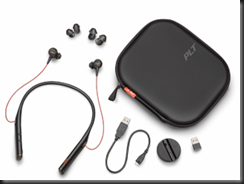
Here is a pretty picture, just so we know what we are talking about.

image

Isn’t that just the world’s best cell phone photograph?  I was going to use the PLT graphics, but that would be just sucking up, because… I am fixing on saying how great the 6200 UC is – maybe only for me, but these things are bordering on being the greatest thing since sliced bread.

As I pondered what to say, I realized that after testing with Skype, SfBO, Teams, and my cell, all to great success; (great audio, pretty good background noise suppression (ANC), and typical excellent Plantronics build quality) that I wanted to continue with Magic Slim and The Teardrops.  That in itself is telling.

Usually I test a device, make some quality comments, observe if it does what my use case scenarios dictate, and determine comfort and audio quality – and then, fair or not, compare to my existing device stable.  In the case of the 6200,  I just kept using them and knowing that I had 9+ hours of battery, I kept testing.  At some point, I stopped testing and just was “using” because this device moved into the “actively used” category.

So, let’s dive in:  According to the aforementioned market-speak:

Features

image

You can get a fancy market-speak sheet to impress your budget approval process.

Fit and Function

The Tsoorad Test Labs says that this 6200 is a 9.9.  I had to adjust to the ear thingies.  Small was too small.  Medium was too medium.  Who uses the large?  The device around the neck thing pretty much was a non-issue.  I like the idea of ripping the earphones out and dropping them, and they go nowhere.  Nice if you are like me and wonder where the earbuds went to.

Laptop, SfBS, SfBO, Teams

All my laptop functions worked as you would expect from Plantronics.  Already paired to my cell phone, inserting the BT600 dongle resulted in a few binks and bonks and wala! working as expected.  I typically do not operate my headset on two at once, I find that the ever-changing volume settings bothersome, and if you are a music at work person, the constant interruptions in the music flow are bothersome as well.  I am sure there is some esoteric setting buried in Windows somewhere to stop that, but I have never found it.  SfB 2016 client picked up immediately.  Teams picked up immediately. 

Audio in/out

Audio quality for voice is very nice.  Good volume control in terms of range of adjustment.  Bass response is at least as good as any other earbuds I have tried.  Microphone pickup sensitivity seems most excellent as well. 

Musically, the 6200 suffers from lack of driver size just like any other set of earbuds – I don’t care who makes them, bass is achieved by moving air, and those little cones in an earbud simply are taxed by bass.  Having said that, the 6200 cranks along right well.

There’s even an APP for that.  Yes Matilda, in the space of just a few minutes I was controlling my 6200 with my phone.  Gosh, how exciting!  Firmware updates, turning things on and off.  I felt empowered.

What’s in the box?

A carry case (actually pretty nice), a short USB cable that connects to either the 6200 or the included charging dock/stand.  And, for you double-up-the-device types, a BT600 dongle so as to enhance the laptop media experience. Oh, and three sizes of ear cushion thingies.

image

Cost

There are various views on this subject.  Personally, I think to a large extent you get what you pay for.  If you want to pay $29.99 for a set of wireless earbuds that are BT, have ANC, and that deliver some serious music reproduction chops, while allowing you to make and take calls on your cell and your laptop, then get ready to be disappointed.  But, if you want something that rocks functional, is durable, with features you can use, and then proceeds to wallop music, then this is the price point for that excellence.  You can get yours right here.

Summary

Usually, in testing I include all the stuff above. The Tsoorad Test Lab Score is limited to the 9.9 (ear bud fitment) so the 10’s I was going to give it in all the other categories got trumped.  I could have said that.  OR…

In this case, I could have just made this statement: “These things are firmly in my “keeper” category.”  Seriously excellent stuff here.

2018/06/14

audiocodes IPP firmware 3.1

A bit ago, I was the recipient of some new Audiocodes firmware for the 405, 440, 445, and 450.  There is an HRS version as well. 420 is not in this cycle.

Happy to report that based on rigorous Tsoorad Lab testing, all seems to be pretty good with this update.  Numerous new features (especially on the 445)  that bear looking at.  In my testing, I did not discover anything wrong – no devices bricked, they all came back working as expected, new features were there, everything worked as before (always a plus).

You can get yours right here. After 3.1 reaches GA, AC will  (I am somewhat convinced as they have in the past)  create and publish the necessary CAB files to enable pushing this update via SfB/Lync webserver methodology.  If you use the IPP Manager (either express or full) the IMG files work for updating – in my environment, it just works.


IPP Manager view of the new goodness:

image

SfB CSCP view of the old goodness – but you get the idea, right?  Just noticed that the HRS image cab is not showing.  I have asked my AC contacts about that.  Time will tell.

image

Either way, YMMV

2018/05/21

Official SfB 2015 Server Disable TLS 1.0 and 1.1 part 3 guidance

updated 20181107


Microsoft update to what they think they are doing, how they are going to do it, and basically, another waffle episode on their part.


https://support.microsoft.com/en-us/help/4057306/preparing-for-tls-1-2-in-office-365


As you may be aware, we have covered the upcoming 31 October 2018 TLS 1.0/1.1 support being removed from O365.  You can find that guidance here.  As promised, Microsoft has finally published the last pieces of the series.
You can find part 3 here.
As usual, I strongly recommend that you start looking at this now – some of this might take a bit of planning and coordination on your part to accomplish in a clean fashion.

Now is the time to get your sales types contacting existing customers and offering to help.  This will not be a clean thing; rest assured that there will be “issues” and IMHO there is significant potential for unintended consequences.

YMMV

2018/05/14

IPP Manager Express Redux

A while back, I did a little write-up of Audiocodes IP Phone Manager Express.  You can read that right here.  A few days ago I installed a newer version and there is enough difference to warrant a redux.  Specifically, I would like to record for my own purposes a configuration that works (so I don’t forget) and maybe you can use it also.

Pre-Conclusion Statement

If you read no further, know this, I like the IPP Manager, I really do.

What are we doing here?

What we need to do is support a number of Audiocodes IP phones – a bunch of 405HD and 450HD models. We want some very basic changes made to the default OOBE configuration, nothing major, but we do want to be able to hand the phone to the user and have it just work.  Audiocodes calls this “Zero Touch” – which was enough of an attraction to get me to try it.  But, I ran into some “difficulties” when I attempted to interpret what somebody thinks is really outstanding documentation into a workable configuration.  After several emails, and several configuration sessions, I managed to achieve parity with the configuration genie. 

Diving In

Installation went as easily as before.  I did not understand the need for a clean server before and I don’t now.  Fuzzy logic on that one.  But, OK, I am in a freebie lab situation.  While the install is happening, let’s verify DHCP Option 160.  And right there we started having issues.  Which option to choose seems to be an ambiguous question as both seem to to work equally well, with ONE of them being preferred, but not required, and no clear (to me) guidance of which is which for my needs.  What I thought would work did not.  I had to use plan B.

Plan A: http://1.1.1.76/firmwarefiles;ipp/dhcpoption160.cfg

Plan B: http://1.1.1.76/firmwarefiles;ipp/tenant/Default

This did not jive with MY reading of the docs.  However, I am sure that I was doing something wrong, so I tried plan B.  At that point I was in Tshooting mode, and I don’t really know if the DHCP Option 160 choice fixed it or if it was the other part I did.  Either way, I found the documentation a smidge confusing.

At any rate

The install churns along, and before too long, we have this lovely “modern” “more visually attractive” “metro” site open on our local machine. You will note the devices already registered – so nice.

image

One of the things I neglected on my first pass through on the config of the tool, was the tenant.  Because the documentation said there was already one there… and so there was!  But it needed a touch of configuring itself, and that was a bit fuzzy as well. This version of the IPP Manager Express requires a “tenant” which is loosely equated to subnets, but could be a separate fiscal entity.  Clearly this line of management tool is meant for something much larger than my little slice of life.  OK, I can work with that.  A few more emails and a few guesses worked out the kinks in that one.

image

If you are doing the “see if the picture matches” thing, here is where you will find the mismatch.  My default tenant picture there is of my lab, where only have one subnet in my lab.  It is just me and my 8 favorite cartoon characters.  254 addresses is more than enough.  But, I have this customer.  You know those pesky customers.  They always seem to expect some sort of defined success.  And don’t you know these folks expected this tool to provision their phones when they have at least 12-15 subnets in the 172.xx.xx.xx/16 range, and the potential for having  SfB clients or a SfB-hosted phone on any of those segments to include the VPN segment.  Yes, Jimmy, I told them not to run the audio/video across the VPN.  You may sit now.

Defining the “tenant” with the proper subnet mask is REQUIRED.  Now, I suppose you could do something dogmatic and create a tenant for each subnet.  You could.  But I did not have a business requirement (see above) for that.  And notice that the subnet in the pic is a MASK not an actual IPv4 address.  We will wait while that runs through a digest cycle.

What we did was define the client subnet as 255.0.0.0 or, /8 which is actually a huge supernet.  But works for the simplicity angle we were also looking for.  We know it is not technically correct to address it that way; but what it did was allow the one IPP Manager to handle ANY address needed.  According to the default tenant in this configuration of  IPP Phone Manager Express, any address that can talk to the server is on a valid subnet.

Moving On

The next thing was the need for a blank template per IPP model (the 405HD and 450HD) and then each needed a customization file.  Included in the install distribution is firmware from about April 2018, and the phones will make use of those firmware files that are newer than the phone. The point here is that I needed to create my own templates before things worked.  I may have (almost certainly) done something wrong in my initial setup.  I know I expected it to be more like my old version – so there is no telling what I did wrong.  I just know that what I have now works. 

Templates

image

I am not going to go through the tenant template file – yours won’t be like mine, but you can clearly see where I have a default tenant configuration template for each phone type and they are tagged (the green/white check mark) as the default.

Once you get this far, you still have a dead stock phone.  Let’s take a look at the edit from here out.  Navigate through the various options and see what is what.   Then click on the button indicated.

That gets you to this:  Fill things out to suit your needs:

image

Make sure that you select the “default” button or not depending on your needs.  You can always go back and make a new one if needed. I know that was needed in my case. Now, you would think that would do it, right?  Well, unless I was making a lot of bad choices, no, now you need to EDIT the entire thing. 

“Ah saved it.”  Huh?  Did I not already do that?  I guess not.

Let’s select “Edit” on our new template.

image

And you get this:

image

Scroll your badself down to the bottom – and there are multiple panes here – confusing as all get out when you work remote…. get to here:

image

Generate your Global Configuration Template for this ONE PHONE MODEL.

image

Woot!

Now, not done yet, we want to edit the template:

Select this “Features” button:

image

In my case I needed the Daylight Savings Time and the Pin Lock.

Here is one, you can figure out the other I think.  But know that when you “SAVE” at the bottom, it will write a secondary config file that the global template will read and enforce.  And that file IS created when you click save.  Don’t ask me, the inconsistency killed me too.

image

Save it…this file is actually located on the ACPhoneMgr drive.

image 

Why the different file saving scheme I have no idea.  But you need both for this to work.  At this point, power cycling a phone does the trick. Phone installs new firmware; reboots, then changes configuration as we want.  So nice.

Conclusion

There is some disconnect between the versions, perhaps due to my lack of mental agility.  This version seems to have some fuzzy documentation – again it could be me.  This is nice piece of kit once you get it cranked. 

PS

I bricked a 450HD while testing this. Phone recovery did not go so well.  Have you ever wondered why a phone with a USB port doesn’t read that port for firmware and as part of the phone bootstrap routine install whatever it finds there?

As always, YMMV


test 02 Feb

this is a test it’s only a test this should be a picture