About Me

My photo
This is a blog for John Weber. One of my joys in life is helping others get ahead in life. Content here will be focused on that from this date forward. John was a Skype for Business MVP (2015-2018) - before that, a Lync Server MVP (2010-2014). I used to write a variety of articles (https://tsoorad.blogspot.com) on technical issues with a smattering of other interests. I have a variety of certifications dating back to Novell CNE and working up through the Microsoft MCP stack to MCITP multiple times. FWIW, I am on my third career - ex-USMC, retired US Army. I have a fancy MBA. The opinions expressed on this blog are mine and mine alone.
Showing posts with label Skype4B. Show all posts

2018/09/24

Logitech Meetup ConferenceCam

In the past, I have used a Logitech cs3000, I had a furious love affair with a bc950, and then I settled down to just using my laptop camera when needed.  Except that did not give me some speaker phone features, no zoom, no pan, no “see the whole room” stuff.

For the last month or so, I have been wringing out a Logitech Meetup.

image

I threw the box away today, because the Meetup now has a permanent spot in the Tsoorad Test Lab.  I find myself using it as a speaker phone AND a video provider on a regular basis.

Here is the Logitech market-speak.

MEETUP

All-in-One ConferenceCam with 120° field of view and integrated audio, perfect for small conference and huddle rooms

  • See everyone, even those close to the camera
  • Works with your video conferencing applications
  • Compact design minimizes cabling and clutter

Furthermore, Logitech claims that:

MeetUp is Logitech’s premier ConferenceCam designed for small conference rooms and huddle rooms. Stop crowding around laptops. With a super-wide 120-degree field of view plus a pan/tilt lens, MeetUp makes every seat at the table clearly visible. With integrated audio optimized for huddle room acoustics, everyone can be heard as well as seen.

The question, of course, is how well are these claims delivered?  Let’s find out.

OOBE

You also get a 16-foot USB cable, power supply, wall mount hardware, and user documentation. The system is certified for use with Skype for Business and Cisco Jabber and offers enhanced integration with BlueJeans, Broadsoft, LifeSize Cloud, Vidyo, and Zoom. That support includes the ability for remote participants to control the camera.

How long are cables?  Dang.  Break out the zip ties if you don’t need all that cable length.  Still, very nice to have.  Sit it on a windows sill, table, shelf, or other flat surface.  Or, mount it to the wall or something like that.  The mount will do both.

I had to put the batteries in the remote control module.  Oh! The horror of it all!

image

But, let’s be somewhat careful and do some reading.  At which point I discover that the included cables won’t do 4k.  You will need an aftermarket cable to get the full bazillion square foot display that some folks want.  Good luck finding a USB 3.x A to USB C cable longer than 1 meter.  I just did 1/2 hour of google-fu and did not come up with anything longer than 10 feet.  And that was $92.  Be that as it may, my myopic senses probably cannot tell you the difference in 1080p and 4K coming out of this camera into a web-based video room.

image

SfB/Teams

Here is the bottom line.  My use of the Meetup device in both SfB and Teams was totally seamless (I also have used the Meetup with Webex Teams, and meetings on Bluejeans and Zoom.  Seamless).  The Meetup is an extension of your local host – a Lenovo T530 running Windows 10 in my case.  Operated perfectly.

image

Zoom/Pan/Tilt

Here’s a problem!  I spent too much time playing with the controls.  Addicting.  In and out. Left, right, up, down.  Fun!  And works well.  There is also a button smack-dab in the middle of the control module that returns the camera to dead center. And there is software for download that works pretty much as advertised.  You can also pair this thing with your BYOD to get access to the speaker phone and control the entire unit if wanted.

No zoom:

image

Zoom

image

Audio Quality

*I* thought the audio quality was quite good.  Volume, minimal distortion (if any) even at high volume levels; good timbre, overall, a solid 9.5 on the Tsoorad Goodness Scale.

Video Quality

I wish it had optical zoom instead of digital.  I mean, it sure looks like digital zoom.  Having said that, it did everything I wanted it to do in video terms.  I am a not possessing the requisite USB 3 cable to enable the 4K, but the 1080p sure looked pretty good to me…zooming in did result in some blurry stuff – I bet the 4K would fix that.  Impressive it is.  9.0 on the Goodness Scale.

Conclusions

Do you have a 6-10 person room?  Are you wanting to park something in there that participants can just walk up to and plug in and voila! they are in a meeting or can start hosting one?  Are you tired of the laptop camera restrictions on that scenario?  Don’t want to spend a large amount of cheddar on a dedicated wall unit like a Surface or other expe$ive system?  Then this Logitech Meetup is probably just right for you!  Typical great build quality, nice feature set, good controls, integration with just about everything, and with great audio/video quality.  What are you waiting for?

You can get one right here.

YMMV

2018/06/14

audiocodes IPP firmware 3.1

A bit ago, I was the recipient of some new Audiocodes firmware for the 405, 440, 445, and 450.  There is an HRS version as well. 420 is not in this cycle.

Happy to report that based on rigorous Tsoorad Lab testing, all seems to be pretty good with this update.  Numerous new features (especially on the 445)  that bear looking at.  In my testing, I did not discover anything wrong – no devices bricked, they all came back working as expected, new features were there, everything worked as before (always a plus).

You can get yours right here. After 3.1 reaches GA, AC will  (I am somewhat convinced as they have in the past)  create and publish the necessary CAB files to enable pushing this update via SfB/Lync webserver methodology.  If you use the IPP Manager (either express or full) the IMG files work for updating – in my environment, it just works.


IPP Manager view of the new goodness:

image

SfB CSCP view of the old goodness – but you get the idea, right?  Just noticed that the HRS image cab is not showing.  I have asked my AC contacts about that.  Time will tell.

image

Either way, YMMV

2018/03/03

FastTrack Network Checking

You may not know but Microsoft is providing a fairly nice tool to check your network for SfB performance.  Free.  Free is a very good price, eh?

I am not going to extol the virtues and services offered by fastrack.microsoft.com, I just want to delve a little into the network checking tool.  And, this tool has been around for a bit.  So, I wanted to get a little updated review.

First off, I cannot even find this thing anywhere on the https://fasttrack.microsoft.com site.  Sorry.  Maybe I am blind,  but I am not seeing it anywhere.  There is probably some zippy button marked “tools” but I am just not groking.  Having said that, I know of

http://ap1-fasttrack.cloudapp.net/o365nwtest

http://em1-fasttrack.cloudapp.net/o365nwtest

http://na1-fasttrack.cloudapp.net/o365nwtest

Here I am checking my lab tenant against the ap1 site.

image

Note the two addresses given by the tool…

image

The 76 address is my laptop, currently operating from a hotel out in the middle of the Oregon Cascade mountain range.  So, this connection is going to be testing from my laptop to the AP1 site to see how things stack up. 

With a little imagination, you could bury a workstation in some remote spot on your network, and pretty much map out the entire path to the world – giving a glimpse into how things line up.  This could be useful, yes?

You can see that the lag from here to there is running about 170 ms, which might be so great in some circumstances. 

image

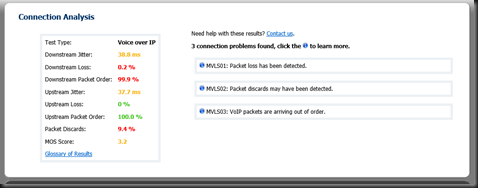
Overall, the tool produces a raft of great info… here is the summary tab.  Note that something is not quite right as the tool cannot simulate VOIP traffic.  Could be something you need to look into here?

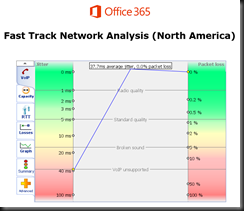
Here is the same test run against the NA1 site.  Note the differences.  We also now have a MOS score.  3.2 is not as good as we want, but doable.  Not too bad for out of a hotel where I am sharing bandwidth with 200 other rooms.

image

image 

We also got some nice jitter measurements on this run…

image

And finally, if you drive into the route tab, you will get more data points.

image

What do you think you could do with information such as this?

image

If you have questions about any attribute/factor measured in these tests, there is also a handy glossary. 


If you or your organization is considering moving to Office 365 in any capacity, this is one of the first tools you should be working. I have been telling customers for a long time that if we do our job right, then any problems will be network, firewall, or load balancers.  This tool can help you prove that.  In a more complex internal net, you might even be able to tell the network team right where to look!


YMMV

2018/02/01

AudioCodes HRS 458 Firmware 3.04.1192

Dropped off an HRS 458 at a customer yesterday, OOBE.  Setup took about 5 minutes (have to hook up cables and whatnot), created an account for it, and powered it up.

A little access to the web interface, and I have a unit up and running, logged into on-premises Skype for Business pool, and dang! 

The HRS starts barfing on finding the calendar for the account.  This is not good.  Some quick checking shows that the environment has no Autodiscover.domain.com record internal, but it does have an SRV.  I know, but don’t ask me.  Not my slice of life at this customer.

However, this does show that an OOBE for the HRS, firmware 3.0.2.xxxx needs to have something other than just an SRV record.

A little judicious communication revealed a new firmware being available for the HRS.  My contact inside AC indicated that his notes showed that the “problem” was resolved with 3.04.1192 release.  What the heck, I tried it. 

image

Voila!  Problem solved.

Of course, now we have to ask why no A record (or CNAME), and why put in the SRV record, not know why it was done, and then never question the mechanics of it, or actually solve the original issue that resulted in the SRV record.  Well, I get to ask at any rate, not sure I will ever get the answers.

YMMV


2018/01/22

SfB SE CMS Master failover success process

Background

You can start by reading this.  This is a tested path forward if you find yourself in the CMS split-brain scenario as described in that article.  After noodling through that process yesterday, and knowing that I have customers who need this to work so as to ETHICALLY meet their SLA/RTO/RTP type stuff, I got to thinking.  And then Josh Walters, a co-worker of mine, made the fateful comment “the server that gets failed over to is happy and functioning, why can’t we just leave it alone?”
In relative age terms, from the mouth of babes…I got to thinking – can I create a process that is repeatable, that comes before the Vale 19-step method, and allow me to confidently tell customers that “this works.”

Scenario

We are ignoring the RGS and the Edge changes necessary for the full site failovoer in this article.  We are totally focused on just the CMS, why it happens (theory on my part), and what to do to recover gracefully in a predictable manner (empirical on my part).
There is actually the option to not perform a CMS failover…I have had environments where the CMS was offline for extended periods of time with no ill effects.  Just don’t change anything.
Our environment is two SfB SE servers, pool paired.  Sfbse.tsoorad.net is the “old” master, sfbse2.tsoorad.net is the “new” master.
After making up the pool pair, we have simulated the datacenter outage by turning off sfbse.tsoorad.net, thereby making the surviving system components think that the CMS master is gone.  Power off is a state that pretty much assures that no-one is talking to that server anytime soon.


The initial CMS server failover goes just fine.  The problem comes up when the “old” master comes back online and thinks that IT is the master.  But the sfbse2 server, the “new” master is in charge, and suddenly, you cannot make changes.  Classic split-brain.  Replication is borked.  Attribute pointers don’t point.  See the blank in this example where the ActiveMasterFQDN might just be something we need to know about.


What is causing this

If my surmise/theory is correct, the split-brain starts when the second node assumes control of the CMS.  No problem.  As a domain member running with the proper authority/credentials, the AD gets changed, the topology gets changed, and the surviving servers in the environment start replicating from what they are told is the CMS.  At this point everything is fine; the split-brain has started, just not affecting us quite yet.
The split-brain posture really gets wound up when the failed server comes back online and it thinks that it is the CMS master.  Understandable.  Before whatever happened happened, that server was indeed the CMS master.  But another server is now designated, and the newly revived server never got re-written, and things are now just a tad stuck.  Again, see this article here, as well as the Mark Vale article here.

What to do about it

The obvious answer, of course, is the easiest.  We will wait right here as you locate your copy of last nights backup script and the ensuing copy of the export-csconfiguration and export-cslisconfiguration and carefully resolve NOT to use them. (they point to the OLD master, and the NEW master is up and running – and in the immortal words of  Josh Walters, “can’t we just leave it alone?)”.  Keep in mind that you don’t HAVE to move the CMS back.  To dovetail with the Savant Walters, we can further notice that the CMS has a failover cmdlet, but no failback cmdlet.
You will make new ones here in the next section and they will be better as they will not reference the original CMS master (pre failure) as the master or being “active”.

Fix me!

From the new master run:
  • export-csconfiguration (we are just being thorough, you should not need this file for this exercise)
  • export-csLISconfiguration (ditto)
  • Place your new exports where you can use them in case you don’t already have them, and then throw them away after the next time your backup captures that data.  If you get the end of all this, and invoke a failback to the “old” master, you can throw the exports away in that case also.  You do have a plan, right? 
  • stop services on “new” master:  FTA, LyncBackup, Master, Replica
Bring the “old” master back online.
  • From the “old” master, stop services:  FTA, LyncBackup, Master, Replica
From the “new” master:
    • install-csdatabase –centralmanagementdatabase –sqlserverfqdn sfbse.tsoorad.net –sqlinstancename RTC –clean –verbose
From the “old” master,
    • start the SfB deployment wizard
    • Run Step 1 (install Local Configuration Store)
    • Run Step 2 (Setup or Remove
    • Start the services stopped earlier BUT DO NOT START MASTER
From the “new” master:
  • invoke-csbackupservicesync –poolfqdn sfbse2.tsoorad.net
Wait a bit, then run through:
Get-CsManagementConnection (should show “new” master)
Get-CsService –CentralManagement
Get-CsManagementStoreReplicationStatus –CentralManagementStoreStatus
Here we are, fixed.  Note that the “new” master is still the master, but now the “old” master thinks it is no longer the master, but subordinate to the “new” master.  All this is just fine.  We don’t care WHERE or WHO holds CMS master, as long as we have a posture where we can read/write topology.


At this point, you could do another Invoke-CsmMnagementServerFailover and get the CMS back over to the “old” master…if you are into consistency like me, then that is what you will do.  If you are like others, you can leave the CMS on the “new” master, and everything will be fine.

Summary

Seeing as how there is no failback cmdlet, could it possibly be that this is all by design, and was never properly documented on the way out of Microsoft-land?
Empirically, as long as both SE pool pair members are up, the CMS failover process is just fine.  If the “old” master is down, things go bad quick and the prudent admin will be prepared to handle that scenario – however remote the possibility may be.
If your CMS fails, then you could be failing also.  Invoke-CsManagementServerFailover is wonderful, provided all the players are still running.  Not so hot when the the existing master is no longer available.  This process will get you in a posture of success; is repeatable, and is not too onerous.  Ergo, we have something i can feel somewhat good about taking to the customer.
YMMV

test 02 Feb

this is a test it’s only a test this should be a picture